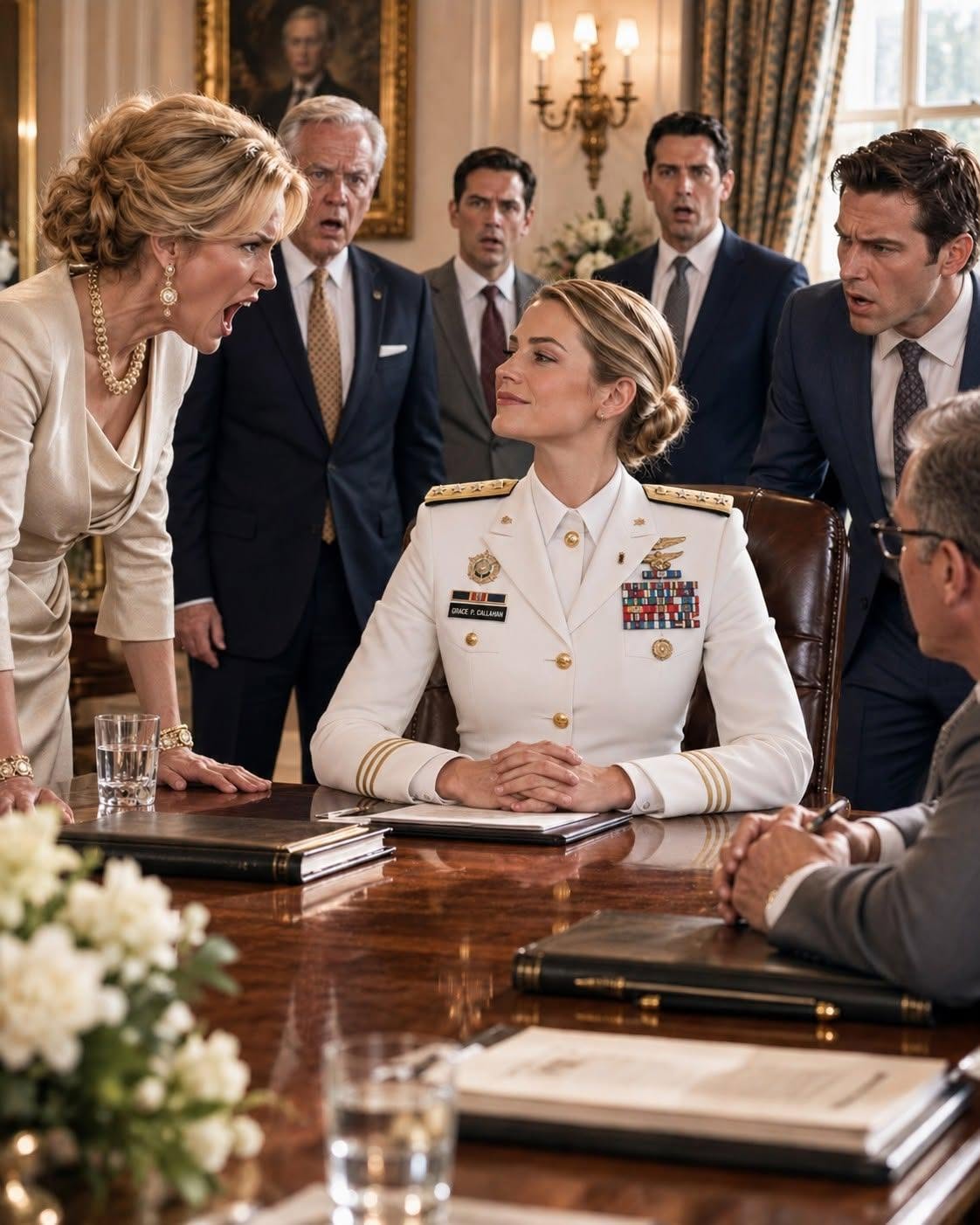
My mother stared at the documents.
“So there’s no loss.”
Martin’s expression hardened.
“That is not what this means.”
“But the money is replaced.”
“No. Your husband used his own assets to prevent employees from suffering while disputed funds are traced.”
She actually looked relieved.
That was when Julian finally broke.
“You still don’t understand.”
She turned.
He stood across from her with tears in his eyes.
“Dad was cleaning up after you while he was dying.”
Victoria slapped him.
The sound cracked through the room.
Nobody moved.
Julian slowly touched his cheek.
Then he laughed.
A broken little sound.
“Thank you.”
My mother stared at him.
“For what?”
“For finally making this easy.”
He took out his phone.
Opened something.
Placed it on the table.
An email.
Sent two days earlier.
From Victoria to Julian.
The subject line:
Sienna Meeting.
The message read:
Just keep her emotional. Once she signs, Richard can move the Boston property immediately. Do not mention the old transfers. She doesn’t understand business anyway.
My mother’s face collapsed.
I looked at Julian.
“You had this?”
He nodded.
“Since Tuesday.”
“Why didn’t you tell me?”
His jaw tightened.
“Because until ten minutes ago, I thought she was talking about normal transfers.”
He looked at Victoria.
“I thought we were pressuring Sienna because you believed Dad’s will was unfair.”
His voice cracked.
“I didn’t know the rest.”
He forwarded the email.
To me.
To Martin.
And to his own attorney.
Then he picked up his jacket.
“I’m done.”
My mother reached for him.
“Julian.”
He stepped back.
“Don’t.”
One word.
Final.
She looked toward me next.
For a second I expected anger.
Instead she whispered, “You’ve won.”
I shook my head.
“This was never a contest.”
“You have the houses. The company. The money.”
“I have documents.”
“You have everything Arthur wanted you to have.”
“No.”
I picked up Dad’s letter.
“I have proof that he spent his last year afraid his own family would take apart everything he built.”
My voice almost broke.
“That isn’t winning.”
Nobody spoke.
Outside, tires rolled slowly over the gravel driveway.
Richard looked toward the window.
Two dark sedans had pulled in behind the SUVs.
Not military.
Not dramatic.
Investigators and outside counsel connected to the corporate review.
Exactly as it should have been.
Richard looked at me.
“You arranged this.”
“No.”
Martin closed his briefcase.
“Mr. Bell, certain records triggered obligations independent of Colonel Sterling.”
Richard’s eyes stayed on mine.
For the first time, he seemed to understand that my so-called ambush had not been soldiers outside the house.
It had not been secret agents.
It had not been power.
It had been preparation.
I had walked into the room knowing I might be pressured.
Dad had spent months preserving evidence.
Martin had maintained independent records.
Daniel had protected the ledgers.
And Victoria had supplied the final pieces herself.
The front doorbell rang.
Nobody moved to answer it.
My mother sat down slowly.
Her kingdom had not collapsed because I outranked her.
It had collapsed because paper remembered what people hoped everyone would forget.
I gathered Dad’s letters.
Then I noticed something on the back of the final page.
A line written in pencil.
Tiny.
Almost invisible.
I turned it over.
My breath stopped.
Sienna—
If it reaches this point, there is one last thing you need to know.
I read faster.
Do not keep the Boston house because I left it to you.
Keep it only if you want it.
And do not spend your life protecting what I built.
Build something of your own.
I pressed my lips together.
Below that was one final sentence.
Also, the loose floorboard in the upstairs study still squeaks. I never fixed it because when you were nine, you hid your report cards under it and thought I didn’t know.
A laugh escaped me.
A real one.
Small.
Painful.
Perfect.
My mother stared.
“What?”
I folded the letter.
“Nothing you’d understand.”
I walked toward the hallway.
This time nobody blocked the door.
Behind me, lawyers were speaking in low voices.
Martin was answering questions.
Julian stood alone near the window.
Richard was staring at the arriving investigators.
And Victoria remained at the head of the table where she had planned to make me surrender my inheritance.
The waiver still lay in front of her.
Unsigned.
Useless.
I stopped at the doorway.
There was one thing left.
I turned back.
My mother looked up.
For thirty years, I had wanted something from Victoria Sterling.
Approval.
Respect.
An apology.
Some sign that underneath all the competition and control, she saw me as her daughter instead of an opponent she had failed to shape.
Standing there, I realized I didn’t need any of it anymore.
“Mom.”
Her eyes lifted.
“Dad didn’t leave me more because I was his favorite.”
Her mouth tightened.
“He left me responsibility because he knew I would ask questions before signing things.”
I looked at the five empty and occupied chairs around her table.
“And tonight, you proved him right.”
Then I walked out.
The night air was cold.
My dress uniform was still hanging in the back of my car.
I opened the door and looked at it.
Colonel Sienna Sterling.
Commander.
Military intelligence.
The identity my family had never bothered to understand.
But for once, I didn’t need the uniform.
I left it in the garment bag.
Three months later, the estate entered formal administration under independent supervision.
The disputed transfers were frozen and traced.
Sterling Regional Construction remained operating because of my father’s restoration trust.
Julian cooperated with the financial review and voluntarily separated his restaurant company from any disputed funding until ownership could be resolved.
Richard’s consulting firm became part of the investigation into the corporate transfers.
My mother challenged portions of Dad’s estate plan.
She had every legal right to do so.
She also had to do it in court.
With evidence.
Not behind locked doors.
And me?
I kept the Boston house.
But not because Dad told me to.
The first weekend after the estate hearing, I drove there alone.
The house smelled exactly the way I remembered.
Old wood.
Dust.
Coffee trapped somewhere in the walls from forty years of family mornings.
I went upstairs to the study.
Found the loose floorboard.
And pried it open.
I expected nothing.
Maybe an old report card.
Maybe one of my childhood notes.
Instead, beneath the board sat a small metal box.
My heart began pounding.
Inside was one photograph.
Dad and me.
I was nine years old.
Missing one front tooth.
Holding a terrible report card behind my back.
Dad was pretending not to notice.
On the back, in his handwriting, were twelve words.
Sienna always thinks the secret is what she hides.
It never is.
I smiled through tears.
Under the photograph was another folded piece of paper.
I opened it.
One sentence.
The real secret is whether you become someone who can face the truth when it is finally uncovered.
I sat on the floor for a long time.
Then I understood.
My father’s final gift had never been the Boston house.
It wasn’t the company shares.
It wasn’t the investment accounts.
It wasn’t even the evidence that saved his estate.
It was the one lesson my mother had never learned.
Power was not controlling the room.
Power was not having five attorneys at your table.
Power was not blocking a doorway, rewriting a family story, or forcing someone to sign because you believed they were too frightened to resist.
Real power was being willing to uncover the truth even when the truth destroyed the version of your family you desperately wanted to believe.
My mother had locked me in a room because she thought that was where she held the advantage.
She believed I was surrounded.
Five lawyers.
A stepfather at the door.
A brother at my side.
A grieving daughter against an entire family.
What Victoria Sterling never understood was that I had spent my career learning something far more valuable than how to command people.
I had learned how to wait.
How to listen.
How to document.
How to let someone believe they controlled the room until they finally revealed exactly what they were trying to hide.
That night in Greenwich, my mother counted five lawyers and saw an army.
I counted five lawyers and saw five witnesses.
And by the time she realized the difference—
the only signature on the table that mattered
was my father’s.