PART 2
Silence.
Not the uncomfortable silence of strangers unsure what to say, but the sharp, instinctive stillness of people who had spent years responding to commands before they had time to think.
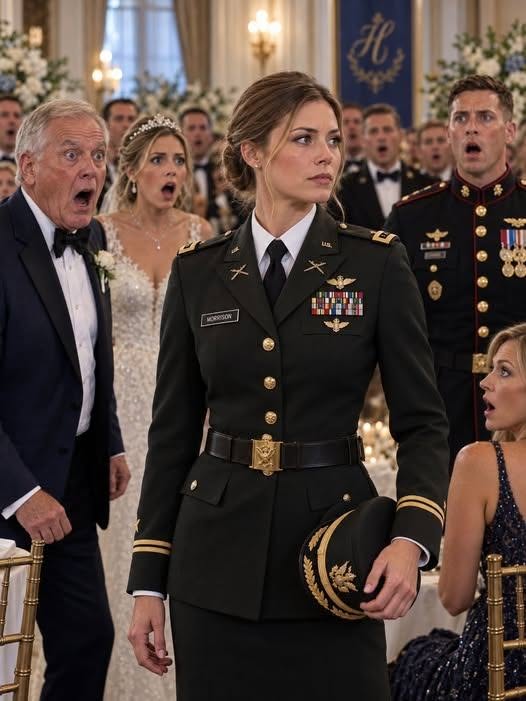
Nearly two hundred men and women were on their feet.
Some were retired. Some still served. A few wore uniforms, while others stood in dark suits and evening dresses. Several faces were familiar to me from briefing rooms, carrier decks, Pentagon corridors, and long nights when decisions had been measured not in hours but in lives.
At the center of them stood Captain Jonathan Reed.
I had last seen him three years earlier aboard the *USS Arlington*, where he had commanded a special operations task group during a complicated deployment in the Mediterranean.
His shoulders were straighter than I remembered.
“Admiral on deck!”
My father’s face went blank.
My mother stopped halfway through lifting her champagne glass.
And Melanie—
Melanie stared at me as though she had forgotten how to breathe.
For one terrible second, I thought my father had been right.
I had ruined her wedding.
Then training took over.
“At ease,” I said.
The room relaxed almost as one.
I looked at Jonathan.
“Captain Reed, unless someone has moved the Atlantic Ocean into this ballroom, I’m fairly certain you’re off duty.”
A ripple of laughter moved through the guests.
Jonathan smiled.
“Old habits, Admiral.”
“Then break this one immediately. Today belongs to my sister.”
I turned toward Melanie.
“I’m sorry.”
Her expression changed.
Not anger.
Not embarrassment.
Something closer to astonishment.
Then Andrew, her new husband, leaned toward her and whispered something.
Melanie laughed.
Actually laughed.
The tension in my chest loosened by half an inch.
Jonathan came over and offered his hand.
“Good to see you, ma’am.”
“You too.”
Behind him, more people approached.
A retired admiral I had known in the Pacific.
A Marine general whose evacuation plan I had approved during a typhoon response.
Two former SEAL commanders.
A Navy surgeon.
A civilian defense analyst who had once argued with me for three straight hours over a procurement schedule and later sent me a bottle of wine with a note reading, *You were right. I remain annoyed.*
I shook hands, accepted congratulations on my retirement, and tried to keep moving.
But every time I glanced toward my family, I saw the same expression.
They were watching a life they had never bothered to understand walk up and greet me by name.
My father recovered first.
He straightened his tie and said something to my mother.
She nodded too quickly.
That familiar ache returned.
Even now, his first instinct was to pretend nothing had happened.
Then someone touched my elbow.
“Claire.”
Melanie.
Up close, she looked exactly like the little sister I remembered and nothing like her at all.
Her hair was pinned elegantly beneath a simple veil. She wore our grandmother’s pearl earrings. There were faint lines around her eyes now, tiny signs of the decades I had missed while imagining her somehow frozen at twenty-five.
“You came in uniform,” she said.
I looked at her carefully.
“Yes.”
She glanced toward Dad.
Then back at me.
“Good.”
I blinked.
“What?”
“I said good.”
Her smile was small but genuine.
“I hoped you would.”
For a moment, the noise of the ballroom seemed to retreat.
“Dad said—”
“I know what Dad said.”
The words were quiet.
Andrew appeared beside her before I could respond.
He was tall, warm-faced, with the slightly overwhelmed expression of a man whose wedding had just acquired an unscheduled military formation.
“Admiral Bennett.”
I gave him a look.
“Andrew, if you call me Admiral at your wedding, I’m leaving.”
He grinned.
“Claire, then.”
“That’s better.”
He kissed Melanie’s temple.
“I need to rescue my best man from Aunt Louise.”
Melanie winced.
“Tell him not to discuss cryptocurrency with her.”
“I’m not getting between those two.”
He disappeared into the crowd.
I turned back to my sister.
“You hoped I’d wear this?”
“Yes.”
“Then why did Dad tell me you didn’t?”
Melanie’s smile faded.
“We should talk.”
Before I could answer, a woman from the catering staff approached to tell Melanie the photographer needed her outside.
My sister squeezed my hand.
“After dinner.”
“Melanie—”
“Please.”
There was something in her eyes I couldn’t identify.
Regret, maybe.
Or fear that whatever she was about to tell me would change more than one evening.
“I’ve waited thirty-six years,” I said. “I suppose I can manage another hour.”
She gave a crooked smile.
“That sounds like you.”
Then she hurried away.
I stood alone beside the dance floor.
“Interesting.”
I didn’t have to turn.
“Ramon.”
Master Chief Ramon Hayes stepped beside me wearing a charcoal suit and a tie covered in tiny anchors.
I looked him up and down.
“That tie should be classified as a hostile act.”
“My wife picked it.”
“Then I withdraw the criticism.”
“Smart woman.”
“Terrifying woman.”
“That too.”
He handed me a glass of sparkling water.
“I’m guessing you discovered the guest list.”
“I’m guessing you knew.”
“I knew some of it.”
“Why are there enough former special operators in this room to invade a medium-sized country?”
Ramon raised an eyebrow.
“Figure of speech, Admiral.”
“I’m retired in six days. I’m allowed figure-of-speech violations.”
He nodded toward the far side of the ballroom.
“Recognize the man talking to your father?”
I followed his gaze.
Tall. Silver hair. Broad shoulders despite his age.
Rear Admiral Thomas Mercer, retired.
Former commander of Naval Special Warfare Command.
I had met him briefly years earlier.
Then I looked toward Andrew.
Then back to Mercer.
“No.”
Ramon grinned.
“Yes.”
“Andrew Mercer?”
“His youngest son.”
I stared.
“My sister married Tom Mercer’s son?”
“Apparently.”
“How did I not know this?”
“That,” Ramon said, “is an excellent question.”
It was more painful than he intended.
Because I knew the answer.
I had not known because Melanie and I barely spoke.
Birthday messages.
Christmas texts.
A call when Mom had cataract surgery.
A call when my ship returned from deployment.
Occasional updates delivered through our mother like diplomatic cables between unfriendly countries.
For years I had told myself Melanie wasn’t interested in my life.
Perhaps she had told herself the same thing about me.
The wedding dinner began.
I found my name card at a table near the front.
Ramon sat two seats away. Admiral Mercer was across from me. Between us sat a Navy chaplain and a woman named Lydia Grant, who introduced herself as director of something called Harbor Bridge.
“What does Harbor Bridge do?” I asked.
Lydia looked surprised.
“You really don’t know?”
There it was again.
That phrase.
“No,” I said.
She glanced toward Melanie.
“We support military families during deployments and transitions. Childcare grants, counseling referrals, employment programs for spouses, emergency travel assistance. That sort of thing.”