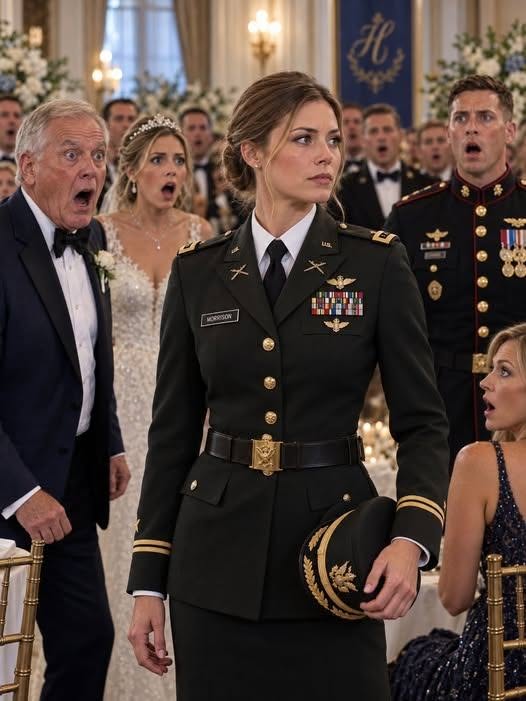
“That sounds useful.”
“It is.”
She smiled.
“Your sister helped build most of it.”
I stopped with my water glass halfway to my mouth.
“My sister?”
“Melanie has been our executive director for seven years.”
I looked toward the head table.
Melanie was listening to Andrew’s best man tell a story. She was laughing, one hand resting over Andrew’s.
“She told me she worked in nonprofit administration.”
Lydia laughed softly.
“That is technically true.”
Admiral Mercer leaned forward.
“It’s substantially understated.”
I looked at him.
“Melanie redesigned half their family-support programs. She also convinced a collection of very stubborn retired operators that asking for help wasn’t a sign of weakness.”
“That sounds difficult.”
“It was.”
He smiled.
“She reminds me of someone.”
I didn’t answer.
I wasn’t sure I could.
Dinner arrived.
I barely tasted it.
Piece by piece, a version of my sister emerged from conversations around the table.
Melanie had spent years working with families whose loved ones disappeared for months at a time.
She understood deployment schedules.
She knew what casualty assistance officers did.
She had sat with spouses through uncertainty, helped teenagers fill out college applications while a parent was overseas, organized welcome-home dinners, arranged emergency flights, and helped retired service members navigate the strange, uncomfortable move into civilian life.
She had done all of it quietly.
I had never known.
“You should hear her talk about you,” Lydia said.
My fork stopped.
“I’m sorry?”
“Your sister.”
Lydia smiled.
“She doesn’t use your name often. Privacy, I think. But whenever a young military spouse says, ‘People at home don’t understand why we do this,’ Melanie always says, ‘I understand more than you think.’”
I stared at my plate.
Thirty-six years of assumptions shifted beneath me.
Across the room, my father was speaking to Admiral Mercer.
He looked uncomfortable.
Mercer said something.
Dad looked toward me.
Our eyes met.
He immediately looked away.
The old reaction rose inside me.
Anger.
But now there was something else beside it.
Curiosity.
After dinner came the speeches.
Andrew’s brother spoke first.
Then his mother.
Then my father.
He walked to the microphone carrying a folded sheet of paper.
My shoulders tightened.
“Melanie,” he began, “has always been the person in our family who understood how to make people feel at home.”
That was true.
He spoke about her childhood.
Her habit of rescuing stray animals.
Her love of music.
The time she organized an entire neighborhood yard sale at fourteen because she wanted to buy our mother a birthday gift.
People laughed.
Melanie wiped her eyes.
Then Dad looked at Andrew.
“You have married a woman who knows how to stand beside people without standing in front of them.”
Something about the phrase bothered me.
Perhaps because I knew exactly who he believed had spent her life standing in front.
He continued.
“And in a world that sometimes rewards noise more than kindness, I hope you never underestimate the quiet strength of the woman beside you.”
Applause filled the room.
I joined it.
He had given Melanie a lovely speech.
Still, part of me wondered why he had always needed one daughter to be quiet in order to praise the other.
Then Melanie stood.
She hadn’t been scheduled to speak.
She took the microphone from Dad.
“I promise this is short.”
Andrew laughed.
“She says that about everything.”
Melanie nudged him.
Then she looked around the room.
“Andrew and I are grateful to all of you for being here. Especially those who traveled a long way.”
Her eyes found mine.
“And especially the people we almost didn’t have the courage to ask for what we really wanted.”
My pulse changed.
Melanie looked down.
“When you grow up in a family, everyone gets assigned a role. Sometimes nobody means to do it. It just happens.”
The room quieted.
“One person is easygoing. One is stubborn. One is responsible. One is difficult.”
Dad shifted beside her.
Melanie kept going.
“And after enough years, you stop checking whether those descriptions are still true.”
She looked at me.
“Sometimes you stop checking whether they were ever true.”
My throat tightened.
Then she smiled gently.
“So tonight I’m grateful for second chances. For new families. And for old families who still have time to learn each other again.”
She raised her glass.
“To Andrew.”
The guests echoed her.
“To Andrew.”
She sat down.
My father did not look at me.
But my mother did.
There were tears in her eyes.
Later, while music filled the ballroom and couples drifted onto the dance floor, I found Melanie alone near the terrace doors.
“All right,” I said.
She exhaled.
“I wondered when you’d corner me.”
“I’m an admiral. We prefer the term strategic positioning.”
She laughed.
For a few seconds, we were sisters again.
Not the admiral and the princess.
Not the difficult one and the good one.
Just Claire and Melanie.
Then I asked the question.
“Did you tell Dad you didn’t want me wearing my uniform?”
“No.”
The answer came immediately.
I searched her face.
“Did you tell Mom?”
“No.”
“Did you tell anyone?”
“No.”
The hurt surprised me with its force.
“Then why would he say that?”
“I don’t know.”
“You must have some idea.”
Melanie looked toward the dance floor.
Dad was dancing slowly with Mom.
“I think he was afraid.”
“Of what?”
“You.”
I almost laughed.
“Dad has never been afraid of me.”
“Yes, Claire. He has.”
She folded her arms.
“Not physically. Not because of your rank. Because you make him face things he spent his whole life avoiding.”
“Such as?”
“Such as being wrong.”
I said nothing.
Melanie continued.
“When you left for Annapolis, he told everyone you were going through a phase. Then you graduated. He said you’d leave after your first tour. Then you didn’t. Every year you stayed meant he had to live with the possibility that the thing he dismissed might actually matter.”
“That sounds like pride.”
“It is.”
She hesitated.
“But it isn’t only pride.”
“What else?”
Melanie looked at me carefully.
“There are things about Dad you don’t know.”
“That seems to be tonight’s theme.”
“I’m serious.”
“So am I.”
She lowered her voice.
“Did you ever ask why he hated the Navy so much?”
“He didn’t hate the Navy. He hated me being in it.”
“Are you sure?”
I opened my mouth.
Then stopped.
My memories had always centered on myself.
*Women don’t belong on warships.*
*You’ll get over this.*
*Why can’t you choose a normal life?*
I had assumed every word was about my ambition.
About his belief that daughters should be smaller.
Perhaps some of it was.
But Melanie’s expression told me that wasn’t all.
“Our uncle Peter,” she said.
I frowned.
“Dad’s brother?”
“You remember him?”
“Barely. He died before I was ten.”
Melanie nodded.
“Dad almost never talks about him.”