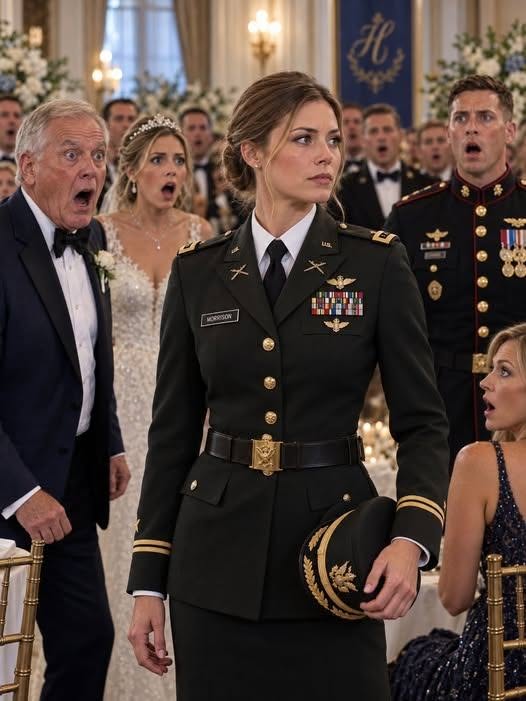
“What does Uncle Peter have to do with this?”
Before she answered, someone behind us said her name.
Andrew.
“Mel, they’re ready for the cake.”
She closed her eyes briefly.
“I have to go.”
“Melanie.”
“I know.”
She took my hand.
“Don’t leave early.”
“I wasn’t planning to.”
“There’s something you need to see.”
“What?”
She glanced toward our father.
“He kept it.”
“Kept what?”
But Andrew called her again.
Melanie stepped backward toward him.
“The proof that you were never as invisible to him as you thought.”
Then she disappeared into the crowd.
I remained by the terrace doors, watching my father dance beneath the soft lights.
For thirty-six years I had believed I understood exactly what he thought of my life.
Now, for the first time, I wondered if I had only known the part he had been willing to say aloud.
PART 3
The cake was lemon with raspberry filling.
I knew this because my mother told me three times while I watched my father from across the ballroom.
“Claire.”
“Hm?”
“You aren’t listening.”
“I heard you.”
“What did I say?”
“Lemon cake.”
“With?”
“Raspberry.”
She studied me.
“You’ve always been irritatingly good at that.”
“Occupational requirement.”
Mom smiled, but the expression did not last.
She knew what I wanted to ask.
I waited.
One of the lessons the Navy teaches you is that silence makes people uncomfortable enough to fill it.
My mother lasted twelve seconds.
“Melanie talked to you.”
“She mentioned Uncle Peter.”
Mom’s shoulders fell.
“Oh.”
“That’s all you have?”
“What would you like me to say?”
“The truth would be interesting.”
“Claire.”
There it was.
My name spoken as a warning.
I was fifty-eight years old, four-star admiral, former fleet commander, and somehow one syllable from my mother could still make me feel sixteen.
But I wasn’t sixteen.
“Why did Dad tell me Melanie didn’t want me in uniform?”
Mom looked toward him.
“He thought it was best.”
“For whom?”
“He was worried tonight would become about you.”
“Melanie wasn’t.”
“No.”
“So he invented the request.”
Mom looked down.
“Yes.”
The answer landed softly.
That almost made it worse.
I had spent the drive to Charleston convincing myself I could tolerate my sister choosing distance.
Now I discovered the choice had not been hers.
“Did you know?”
“Not until after he sent it.”
“But your message—‘Don’t upset your father.’”
“I was trying to prevent an argument.”
“You were asking me to surrender before one started.”
She winced.
“I suppose I was.”
Around us, guests laughed as Andrew tried to cut the wedding cake and nearly dropped the knife.
My mother watched them for a moment.
“I’ve spent most of my marriage keeping the peace.”
“I know.”
“I used to think that was the same as solving things.”
I looked at her.
“And now?”
“Now I think sometimes it only teaches everyone which person is expected to give way.”
For once, she did not have to tell me who that person had been.
I leaned against the wall.
“What happened to Uncle Peter?”
Mom sighed.
“He joined the Navy right after high school.”
“I know that.”
“Your father practically worshipped him.”
That I hadn’t known.
Peter had always existed in our family history as a photograph on my grandmother’s piano. A young man in a white uniform with an easy smile.
“He was younger than your father by three years,” Mom continued. “Restless. Funny. Always going somewhere.”
“What happened?”
“Training accident.”
I looked at her sharply.
“He wasn’t killed in combat?”
“No.”
“Dad always let me believe—”
“Your father never corrected anyone.”
“When?”
“1971.”
Dad would have been twenty-five.
“Peter was twenty-two,” Mom said.
For the first time, I imagined my father not as the rigid man behind a newspaper but as a twenty-five-year-old standing beside a coffin.
“He blamed the Navy?”
“He blamed everything.”
“Then why not tell me?”
“Because by the time you wanted Annapolis, his fear had hardened into certainty.”
“That women didn’t belong there.”
Mom nodded sadly.
“He believed that too, Claire. I’m not going to rewrite history for him.”
I appreciated that.
“But fear was underneath it.”
“He could have said he was afraid.”
“Yes.”
“He could have said he loved me.”
“Yes.”
“He could have said he was proud.”
“Yes.”
My mother’s voice broke on the last word.
I looked away.
Outside the tall ballroom windows, Charleston glowed beneath a clear evening sky. The rain from Norfolk had never reached us.
“He has followed your career,” Mom said.
“What does that mean?”
“Exactly what it sounds like.”
“He barely knows what I do.”
“He knows more than you think.”
I gave her a skeptical look.
“Claire, he knows the names of ships you commanded.”
That silenced me.
“He knows when you made rear admiral. He knows the year you took command of Second Fleet. He knows which hurricane response you led. He knows—”
“Stop.”
Mom did.
My chest hurt.
“Why?”
“I don’t know.”
“Yes, you do.”
She considered that.
“Because loving someone and knowing how to love them are not the same skill.”
I closed my eyes.
For three decades I had wanted my father to care.
Now the possibility that he had cared badly was almost harder to hold.
“Where is this proof Melanie mentioned?”
“In our hotel room.”
“What is it?”
Mom hesitated.
“That belongs to your father.”
“Mom.”
“Not my secret.”
I laughed once, without humor.
“We’re a little old for family secrets.”
“Then ask him.”
I looked toward the dance floor.
My father was no longer there.
“Where did he go?”
Mom pointed toward the terrace.
Outside, the air was warm and smelled faintly of jasmine from the hotel gardens.
Dad stood alone near the stone railing.
His jacket was unbuttoned.
The city lights shimmered beyond him.
I walked over.
“You always hated parties,” I said.
He didn’t turn.
“I’m eighty. I’m allowed to hate whatever I like.”
“That certainly explains a few things.”
A corner of his mouth moved.
Almost a smile.
Almost.
Then he saw my uniform again.
His expression tightened.
“I suppose you’re pleased.”
The old anger sparked.
“With what?”
“The entrance.”
“No.”
He finally looked at me.
“You expect me to believe that?”
“Yes.”
“You walked into a room and everyone stood up.”
“I didn’t ask them to.”
“But you enjoyed proving your point.”
“What point?”
“That you matter.”
There it was.
I could have answered sharply.
I had done it a thousand times.
Instead, I asked, “Why does that bother you?”
His eyes narrowed.
“It doesn’t.”
“Then why are you angry?”
“I’m not angry.”
“Dad.”
“Don’t interrogate me.”
“I’m not interrogating you. I’m asking.”
He looked away.
“Melanie said you lied about her wanting me out of uniform.”
His jaw tightened.
“I was trying to protect her day.”
“She didn’t ask for protection.”
“She doesn’t always know what she needs.”