We agreed on something practical. Every other Sunday afternoon, I would take Sophie and her brother. Not because Emily needed coverage, because I wanted time with my grandchildren. If I had plans, we would move it. No guilt, no assumptions. It felt almost embarrassingly simple.
Gary was harder. That did not surprise me. For nearly forty years, he had been the person most accustomed to me smoothing out his life.
When he finally came to Denise’s house, he brought one of my suitcases. For a second, I thought he expected me to pack up and go home with him. Instead, he set it by the door. “You left some things you might need.” That was better than roses.
We sat on Denise’s porch. Gary looked older than he had a week earlier. He told me the company was interviewing administrative candidates. He told me losing Greenfield had hurt. He told me the employees were still talking about the meeting. I listened. Then I realized something. He was still talking about consequences. His consequences. The lost account, the embarrassment, the extra payroll expense.
Finally, I interrupted him. “Gary.” He stopped. “You’re still telling me what my leaving cost you.”
His face tightened. “That’s not what I’m doing.”
“It is.”
He looked away. I asked the question that had been sitting inside me for days. “Do you miss me or do you miss what I did for you?”
He opened his mouth, then closed it. For once, Gary Mercer had no quick answer.
I stood. “Don’t answer because you think you know what I want to hear.”
“Linda, I mean it.”
He looked at me. “When you know the difference, call me.”
He left without arguing.
That evening, I expected to feel empty. Instead, I felt strangely light.
The next morning, I enrolled in the watercolor class I had postponed three times. A week later, I drove to Cincinnati to spend the night with an old friend. I did not cook Gary meals before I left. I did not remind anyone where I was going. I bought myself a set of brushes that cost more than I normally would have spent. The old me would have looked at the price and thought of whose bill I could help pay instead. This time, I bought them.
Meanwhile, Gary hired an operations administrator, a real one, with a salary, benefits, and an actual job title. A few weeks later, he called me not to ask when I was coming home. Not to ask where something was. He simply said, “Would you meet me for coffee?”
We chose the diner where we used to eat when we were newly married. When I sat down across from him, Gary wrapped both hands around his mug. Then he finally answered my question.
Gary looked down at his coffee for a long time before he spoke. Then he said, “At first, I missed what you did.”
I had expected an apology, maybe a speech, maybe some version of I miss my wife. Instead, he gave me the one answer I had not prepared myself for, and somehow, because it was honest, I trusted it more.
He rubbed his thumb along the edge of the mug. “When you left, I was angry. I thought you were punishing me.” I said nothing. “I hated not knowing where things were. I hated having to explain myself at work. I hated that the kids were calling me asking what was going on.” He gave a small bitter laugh. “I really hated writing a paycheck to someone for work you used to do for free.”
That almost made me smile. Almost.
Gary looked up. “I’m not proud of that.”
“You shouldn’t be.”
“I know.”
He nodded. The waitress came by and topped off our coffee. Neither of us spoke until she walked away.
Gary continued. “The first week, all I wanted was for everything to go back to normal.”
There was that word again. Normal. The word people use when what they really mean is comfortable.
“For me,” he said. “Not for you.”
I felt something in my chest loosen. He had finally understood that part.
“The new administrator started last week.”
“How is she?”
“Annoyingly competent.”
I laughed despite myself. Gary smiled for half a second, then turned serious again. “She found three things I should have been tracking months ago. Nothing terrible, just things you always handled before I even knew they existed.”
“That sounds familiar.”
“It does now.”
He looked toward the window. “And once she started doing the office work, the panic stopped.” I waited. “I learned the prescription system. I figured out the utility accounts. I even did laundry.”
“Congratulations.”
“I turned two white undershirts pink.”
“That sounds more believable.”
He laughed, but this time I laughed, too. Then his expression changed. “After a while, there wasn’t anything left for me to blame you for.”
That sentence hit harder than I expected.
Gary leaned forward. “The house still worked. The business still worked. The kids figured their own stuff out.” He paused. “But you were still gone.” I looked at him. “That’s when I understood the difference.” His voice was quieter now. “I stopped needing you to fix everything.” He swallowed. “And I still wanted you there.”
For a few seconds, I couldn’t speak. That was the answer I had wanted. Not because it was romantic. Because he had arrived at it the hard way.
He went on. “I also owe you something more specific.” I waited. Gary sat back. “I made my wife the punchline in front of our children because I thought I was being funny.” He did not say I had misunderstood. He did not say everyone was drinking. He did not say it was only a joke. He looked directly at me. “I humiliated you.”
My eyes burned. He continued. “And Jason and Emily laughed because I taught them over a lot of years that making fun of you was harmless.”
That part hurt, but it also mattered.
“I’m sorry,” he said. Not dramatic, not polished, just tired and sincere.
I looked down at the table. “Thank you.”
Gary did not ask whether that meant I was coming home. That was another change. Instead, he said, “I apologized to the employees.”
“I know.”
“Sheila told you?”
“No. Jason did.”
He nodded. “I also talked to Jason and Emily.”
“What did you say?”
“That I helped create the habit of treating you like the family manager instead of a person.” He sighed. “Jason didn’t enjoy hearing that.”
“I’m sure.”
“Neither did I.”
We sat there for another hour, not solving forty years of marriage, just talking. That afternoon did not magically restore everything. I did not pack my suitcase and go home.
Instead, Gary and I started doing something we had not done in years. We spent time together without needing anything from each other. Coffee one week, dinner the next. A walk through Franklin Park Conservatory on a rainy afternoon, a movie where Gary bought the popcorn and did not ask me to hold his wallet, his glasses, or his phone.
There were still awkward moments. Once while we were having lunch, he asked, “Did you remember to call the dentist?” I just looked at him. He froze. Then he said, “Never mind. I’ll call.” I smiled. Progress.
Eventually, I went home, but not to the same arrangement. Gary kept the operations administrator. That was non-negotiable. At home, we divided responsibilities more clearly. He handled his prescriptions, his appointments, and most of his own laundry. We alternated grocery shopping. I stopped being the default keeper of every family calendar.
My inheritance stayed mine. If Jason or Emily needed financial help, they could ask. I could say yes. I could say no. Either answer had to be respected. Holiday hosting started rotating. Child care became something Emily and Jason requested instead of assumed.
The biggest rule was also the simplest. If someone was the subject of a joke and they were not laughing, the joke stopped.
The family did not transform overnight. Jason still occasionally called and started with, “Mom, can you just—” then caught himself. Emily once texted me about an emergency school pickup, then followed it with, “If you already have plans, don’t change them. I’ll figure it out.” That one nearly made me cry.
Nearly a year passed. Mother’s Day approached again.
A few days before, Gary asked what I wanted to do. “Nothing big,” I said. He nodded. “Good.” I narrowed my eyes. “Good?” He smiled. “Because you’re not doing anything.” That made me suspicious.
On Mother’s Day morning, I woke to voices downstairs, cabinet doors, someone dropping something metal, Jason saying a word I hoped the grandchildren had not heard. Then I smelled coffee.
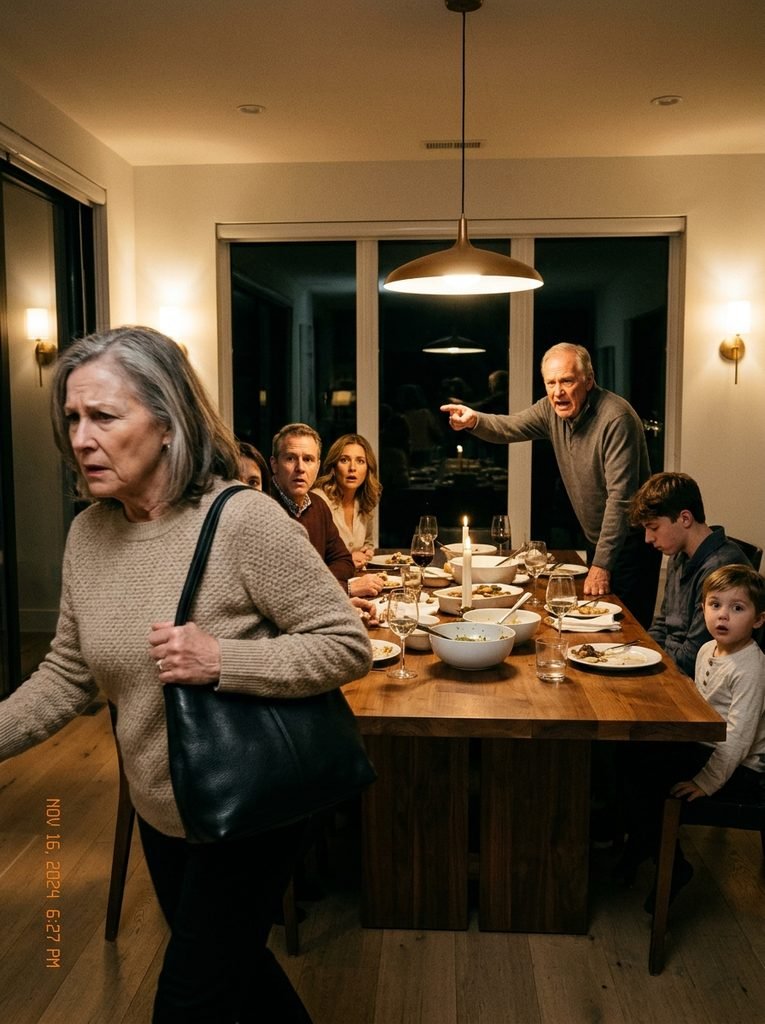
I walked toward the kitchen. For one second, I was back at that table a year earlier. Gary turned. He had a coffee mug in his hand, and then he raised it. For one brief second, my whole body tightened.
Gary stood in our kitchen with a coffee mug raised in his hand, and I was back at that Mother’s Day table a year earlier. The laughter, Jason clapping, my purse in my hand. The feeling that thirty-nine years of being useful had somehow become something everyone was entitled to joke about.
Gary saw my face change. His smile faded. Then he said very gently, “Relax. I learned my lesson.”
Jason was standing at the stove with a spatula in one hand. “Barely,” he said. Smoke curled from a skillet. Emily laughed.
I looked around the kitchen. There were pancakes on the counter. Some were golden. Some looked like roofing shingles. Emily was cutting strawberries. Sophie and her little brother were arguing over where to put a vase of flowers. Megan was setting out plates.
Nobody had asked me to bring anything. Nobody had asked me where the syrup was. Nobody had asked whether I had remembered somebody’s medication, appointment, bill, or schedule. I was just standing there. That almost felt stranger than the toast.
Gary lifted his mug again. This time, his voice was quiet. “Here’s to Linda.” The room settled. He looked at me. “The woman we’re lucky enough to have in this family.” Then he added, “And the woman none of us is entitled to.”
No punchline, no grin, waiting for everyone to laugh at my expense. Just the truth.
Jason pointed the spatula at me. “And nobody lets Mom touch the dishes.” I stared at him. He lifted both hands. “I’m serious. I already ruined breakfast. I can ruin cleanup, too.”
I laughed. And that mattered more than I can explain because this time I was part of the joke, not the target of it.
I sat down at the kitchen table. Gary brought me coffee. Emily put a plate in front of me. Jason served the least burned pancakes.
For years, I had thought love looked like being the first person up and the last person to sit down. That morning, love looked like letting other people struggle with a skillet while I drank coffee.
Sophie sat beside me. “Grandma, Dad burned the first batch.”
“I heard.”
“He said the pan was defective.”
From across the kitchen, Jason said, “It was suspiciously aggressive.”
Sophie rolled her eyes. “He burned them.”
“I believe you.”
Everyone laughed. So did Jason. That was the difference.
A little later, Emily sat beside me while the others cleaned. She leaned close. “Can I ask you something?”
I smiled. “You just did.”
She gave me a look. “Very funny. What do you need next Saturday? I have that work conference downtown. Would you want the kids for a few hours?”
The old answer rose automatically. Of course. Then I remembered. Saturday morning was my watercolor class. A year earlier, I would have cancelled without thinking. I would have told myself I could paint another day.
I looked at Emily. “I can’t Saturday morning.”
She nodded immediately. “Okay.” No disappointment, no sigh, no guilt.
Then I said, “I’m free Sunday afternoon if that helps.”
Her face brightened. “That would be perfect.”
And that was it. A problem discussed between two adults. No emergency, no resentment, no invisible obligation.
Later, Sophie handed me a folded piece of construction paper. The front was covered in crooked flowers and glitter. Inside, she had written, “Grandma, thank you for being my grandma. You don’t have to do anything else.”
I read it twice, then a third time. My throat tightened.
Sophie watched me carefully. “Do you like it?”
I pulled her close. “I love it.”
She hugged me back. I thought about the voicemail she had left one year earlier. The only message out of sixty-three that had asked nothing from me. That little girl had understood something the adults had missed. She loved me for being there, not for what I could fix, not for what I could pay, not for what I could remember, just for being her grandmother.
The family was better now, not perfect. Gary still forgot things. Jason still occasionally started a request with, “Mom, could you just—” and then stopped himself. Emily still had bad weeks when she leaned on me more than usual. And I still had to catch myself sometimes. That was my part in all of this.
For years, I had rushed in before anyone had a chance to struggle. I had called it love. Sometimes it was. Sometimes it was fear. Fear that saying no would make me selfish. Fear that being less useful would make me less needed. Fear that if I stopped doing everything, people might discover they could live without me.
What I learned was simpler than that. People can live without you solving everything for them. That does not mean they can replace you.
After breakfast, Gary and Jason cleaned the kitchen. I did not inspect their work. That may have been my greatest act of growth.
I took my coffee onto the back porch. The spring air was cool. A few minutes later, my phone buzzed. One
message. I glanced down. It was from Sophie. She was sitting ten feet away inside the kitchen. The text read, “Best Mother’s Day ever. Also, Dad burned the pancakes.”
I looked through the window. Jason was scraping a blackened pancake off the bottom of a pan while Sophie laughed at him. Jason looked at her and started laughing too.
I smiled.
A year earlier, sixty-three missed calls had taught my family what happened when I stopped carrying everything. This year, one silly message was enough.
That afternoon, I saved Sophie’s message, just like the year before. And once again, the last message made me smile.

