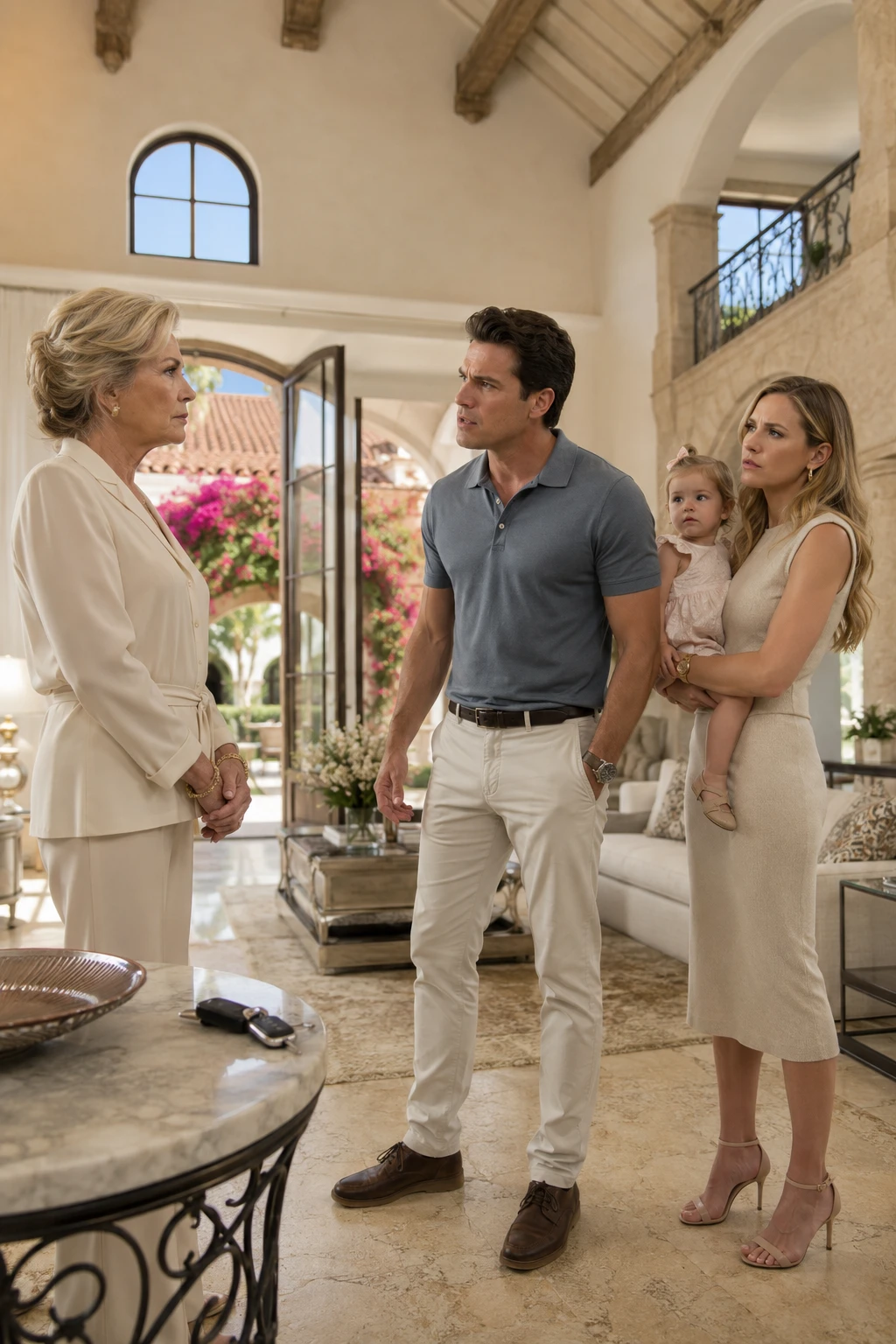
The first time my son saw my new villa, he did not congratulate me.
He walked through the front door, stared up at the vaulted ceiling, and decided it belonged to him.
Three weeks earlier, Preston had stood inside my cramped apartment behind a laundromat in Sarasota and looked at me as though my life had become a warning.
The place had one bedroom, chipped cabinet doors, and a window facing a brick wall. Industrial dryers rumbled from dawn until midnight, and everything smelled faintly of detergent. It was not beautiful, but after thirty-four years of marriage, it was the first place where no one could order me to be quieter, smaller, or more grateful.
Preston folded his arms in my narrow kitchen.
“Mom, you’re sixty-one. You need to start being realistic.”
His wife, Kendra, stirred coffee she never drank.
“There’s nothing wrong with renting,” she said. “For some people.”
Some people.
That was what I had become after raising Preston, paying for braces, college applications, car repairs, and the wedding he and Kendra could not afford. I had spent decades making everyone else secure while my own needs waited.
I smiled and said nothing.
Neither of them knew my grandmother had left me two modest rental properties before I married Preston’s father, Richard. I had kept them separate and never placed Richard’s name on either deed.
During the divorce, I sold both.
Then I bought a white Mediterranean-style villa near the bay.
It had arched windows, pale stone floors, a guesthouse, and bougainvillea spilling over the courtyard wall. For three weeks, I told no one. I drank coffee beneath the palms, unpacked my grandmother’s china, and painted one wall pale blue simply because I liked it.
For the first time in decades, no one mocked my choices.
Then a neighbor posted photographs from my housewarming dinner.
By Saturday morning, Preston’s black SUV was rolling through my gate.
Kendra stepped out with their baby, Lila, on one hip. Her eyes moved over the windows and garden as if measuring curtains. Preston entered without knocking, looked around, and smiled.
“This is perfect.”
“Yes,” I said. “It is.”
He turned to Kendra. “My wife is going to love living here.”
I stared at him. “Excuse me?”
“Come on, Mom. This place is too large for one person. Kendra and I will take the main house. You can stay in the guesthouse.”
Kendra rocked Lila gently. “It would be wonderful for her.”
My heart softened when I looked at my granddaughter.
Not when I looked at them.
“You are not moving into my house.”
Preston’s smile vanished.
Kendra’s voice sharpened. “Family is supposed to support family.”
“That’s interesting. When I lived behind a laundromat, both of you called it being realistic.”
Preston placed his keys on my marble side table as though ownership had already transferred. Their lease was expiring, he explained. Rent was wasted money. I should be grateful to have family nearby.
“No.”
The word seemed to shake the room.
Kendra tightened her hold on Lila. “So you’d rather your granddaughter grow up in a cramped apartment while half this house stays empty?”
“I would rather she grow up knowing another person’s home is not something she is entitled to take.”
Preston’s face turned red.
“You think buying an expensive house suddenly makes you powerful?”
“No,” I said. “I think it means I am finally home.”
For a moment, no one spoke.
Then Preston pulled a folded document from his jacket.
“You really should have read the paperwork more carefully, Mom.”
At the bottom was a signature.
My signature.
Except I had never signed it.